Vehicle Decontamination in Las Vegas: Why It Matters Before Any Coating
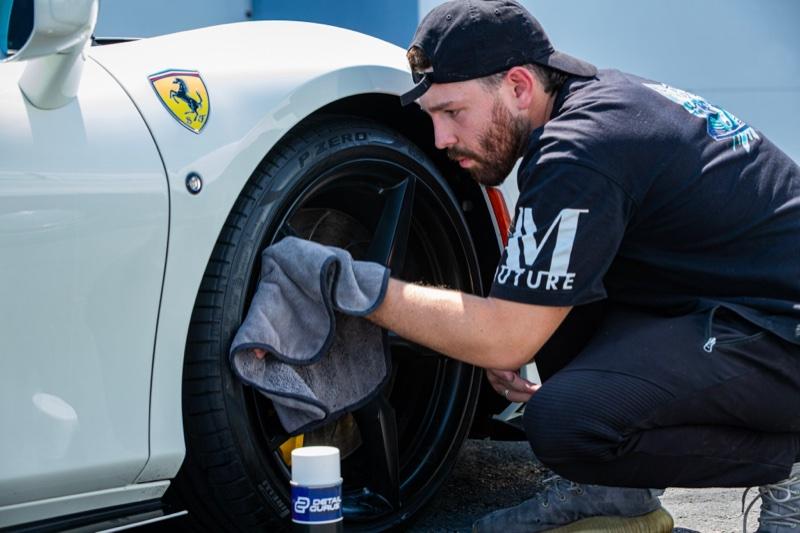
Vehicle decontamination is the multi-step process — iron remover, tar remover, clay bar, and an alcohol wipe — that strips bonded contaminants a normal wash leaves behind, and it's the invisible 3–5 hour step that decides whether a ceramic coating actually lasts. In Las Vegas it matters more than almost anywhere else because of one specific contaminant: embedded iron from freeway brake dust. Here's what's really on your paint and what a proper decon stack looks like.
What "contamination" actually means on your paint
After a normal wash, your paint feels smooth from a distance but rough up close. Run a clean, dry hand across the hood. If it feels like fine sandpaper instead of glass, you have bonded contamination. That texture isn't dirt — soap won't touch it. It's a mix of embedded iron particles, road tar, tree sap, hard-water minerals, and microscopic industrial fallout that has chemically bonded to the clearcoat.
On a daily driver in Las Vegas, that bonded layer builds up in 4–6 months. On a fleet truck or anything parked outside near a freeway, it builds up in 6–8 weeks. Once it's there, nothing in your wash routine removes it. That's what decontamination is for.
The iron problem on Las Vegas freeways
Iron contamination is the single biggest issue I see on Las Vegas paint, and most clients have never heard of it. Every time anyone hits the brakes, the brake pad and rotor shed microscopic iron particles. Those particles are hot and slightly magnetic, and they get launched off the wheel at speed and embed themselves into the paint of every car within range. On I-15, I-215, and the 95, that's basically everyone.
Once embedded, iron particles oxidize. They turn into tiny rust spots inside your clearcoat. Left alone, they continue to corrode and eventually push up through the surface as visible orange specks — usually first noticed on white and silver cars where the contrast is obvious.
When you spray an iron remover on a contaminated panel, it reacts with the iron and turns blood-red or deep purple. The first time someone sees their "clean" white hood bleed purple, they get it. There's a video of this on most detailer pages for a reason.
The 5-step decon stack we actually use
Every car that comes through for paint correction or ceramic coating goes through this exact sequence. It takes 3–5 hours depending on size and severity, and we do it in this order for a reason — each step removes a different class of contaminant so the next step works correctly.
Step 1: Pre-rinse and foam soak
Before we touch the paint, the car gets a thorough rinse and a citrus pre-soak foam to break down surface dirt, bug guts, and any loose road grime. This isn't decon — it's removing the easy stuff so we're not dragging it across the paint during the next steps. Five to ten minutes of dwell, then rinse.
Step 2: pH-neutral two-bucket wash
A real two-bucket hand wash with a pH-neutral shampoo and clean mitts. Top down, panel by panel. The goal is to physically remove every loose particle so that nothing gets pressed into the paint during the chemical decon steps. This is where shops cut corners — a single bucket and a foam gun is faster, but it just smears contamination around.
Step 3: Iron remover
Spray a dedicated iron remover (we use a thiol-based reactive chemical) on every panel including wheels, let it dwell 3–5 minutes until it bleeds purple, agitate with a soft brush in heavy areas, then pressure-rinse. On a Vegas vehicle that's never been decontaminated, the panels look like a crime scene. That's working.
Step 4: Tar and adhesive remover (targeted)
Spot-treat road tar, asphalt splash, adhesive residue from old badges or pinstripes, and any tree sap. This is a solvent-based spray that dissolves petroleum contamination. Apply with a soft cloth, let it dwell, wipe clean. Skipped on cars that show no tar contamination.
Step 5: Clay bar or clay mitt pass
The mechanical decon step. With heavy quick-detailer lubrication on the panel, we glide a clay bar or clay mitt across every surface. The clay grabs any remaining bonded grit — silica from road dust, paint overspray, mineral deposits — and lifts it off the surface. You can hear the change. Contaminated paint sounds gritty under clay; clean paint glides silently.
After clay, the paint is chemically and mechanically clean. Run a hand across it and it feels like glass. Now it's ready for correction.
Why coatings fail without decon
Ceramic coatings work by forming a silica cross-link bond to your clearcoat. That bond needs a clean surface to attach to. If iron particles, tar, sap, or bonded grit are sitting on the clearcoat when the coating goes down, the coating bonds to the contamination — not the paint. A few months later, the contamination oxidizes and pushes the coating away from the surface in patches. The car develops dull spots, hydrophobic performance dies in those areas first, and the warranty doesn't cover it because the failure traces back to prep.
I've inspected dozens of failed dealer coatings and bargain-shop coatings over the years. The single most common cause of premature failure is rushed or skipped decon. The coating itself is usually fine. The foundation underneath it wasn't.
What's actually included
| Service | Vehicle Size | What's Included |
|---|---|---|
| Decon Wash (standalone) | Sedan / Coupe | Pre-rinse, foam soak, two-bucket wash, iron remover, clay bar pass. No correction. |
| Decon Wash (standalone) | SUV / Crossover | Same stack, larger surface area, more product, more time. |
| Decon Wash (standalone) | Truck / Lifted | Same stack, heavy contamination expected, often longer iron-out dwell and additional tar treatment. |
| Decon (included in coating) | Any | Same 5-step stack, included in every ceramic coating package — never an upcharge. |
Pricing depends on vehicle size and contamination level. As a standalone service, decon makes sense once or twice a year for any Las Vegas vehicle you care about. Bundled with a paint correction or ceramic coating, it's the foundation step — included in the package, never an add-on.
When you can actually skip decontamination
There are a few cases where I'll tell a client they don't need a full decon:
- A brand-new car under 30 days from delivery with no freeway miles. Light wipe-down only.
- A vehicle that was professionally decontaminated within the last 90 days and has stayed garaged.
- A vehicle being prepped for sale at low value, where the cost-benefit doesn't make sense.
- A car that's about to get a full repaint anyway.
Outside those situations, every Las Vegas vehicle benefits from decon at least once a year. Twice a year if you commute on I-15 or park near an active construction zone.
How to spot a shop that skips it
If you're shopping ceramic quotes around town, ask three specific questions:
- 1.What brand and type of iron remover do you use? A real answer mentions a specific product (CarPro Iron-X, Gyeon Iron, Koch-Chemie Reactive) and a 3–5 minute dwell time. A vague answer like "we use a special spray" is a red flag.
- 2.Do you clay the entire car or just the hood? Full-car clay takes 60–90 minutes. Hood-only takes 15. If they don't volunteer "the entire vehicle," assume hood-only.
- 3.Can I see photos of the iron-out step on a recent car? Every detailer who actually does it has photos. The purple bleed is too dramatic not to document.
Related reading
If you're planning a ceramic coating, read our breakdown of 2026 ceramic coating prices in Las Vegas and the owner's prep checklist for the week before your appointment. Decon is also the step that comes right before paint correction, and it's included in every coating and film package on our paint protection page. Knowing what the whole prep flow looks like helps you compare quotes accurately.
Book a decon wash or full ceramic prep
Standalone decon or bundled with paint correction and coating. We quote both so you can see the path that makes sense for your vehicle.
Book DecontaminationQuick Answers
Vehicle decontamination is the process of removing bonded contaminants from your paint that a normal wash leaves behind. That includes embedded iron particles from brake dust, tree sap, road tar, industrial fallout, hard-water mineral deposits, and the bonded grit you can feel by running a clean hand across the clearcoat. It's a multi-step process — iron remover, tar remover, clay bar or clay mitt, and an isopropyl alcohol wipedown — that gets the paint chemically clean before any correction or coating.
Vehicle decontamination pricing in Las Vegas depends on vehicle size, contamination level, and whether it's a standalone service or bundled with ceramic prep. A standard sedan with light contamination prices very differently from a lifted truck that hasn't been decontaminated in 3+ years. Expect the work to take 3–5 hours of careful labor — it's not a quick service — and we quote in writing before any work starts.
Decontamination is different from washing. A wash removes loose dirt; decontamination removes contaminants that have chemically or mechanically bonded to the paint. After a wash, run a clean hand across the hood — if it feels rough or gritty, you have bonded contamination that no soap will lift. That's the test. Most Las Vegas cars more than 6 months old fail it.
Done correctly, no. A clay bar or clay mitt glides on a lubricated surface and lifts contaminants up without dragging them. Done wrong — too little lubricant, dirty clay, or a contaminated mitt — yes, it can introduce micro-marring. That's why decon is followed by paint correction in our process. If we cause any marring during clay, we polish it out before the coating goes on.
No, and any shop that lets you is gambling with your money. Ceramic coatings bond to the top layer of your clearcoat. If that top layer is contaminated with iron, sap, or bonded grit, the coating bonds to the contamination, not the paint. Six months later the contamination oxidizes and the coating starts failing in patches. Decon is the foundation. Skipping it is how a 5-year coating turns into a 14-month coating.
Founder & Lead Detailer, Aqualine Performance. Pacific F2000 driver and track instructor at Dream Racing (Las Vegas Motor Speedway).
Keep reading
Boat and RV Detailing in Las Vegas: Lake Mead Hard Water, Desert UV, and What Actually Protects Them
Lake Mead's alkaline hard water and Las Vegas's ~294 annual sunny days do more damage to boat gelcoat and RV paint than most marina climates. Here's the honest breakdown of what detailing and ceramic coating fix, what each costs, and when the investment doesn't pencil out.
Car Interior Detailing Cost in Las Vegas: What You'll Pay and Why
Interior detailing in Las Vegas runs $299 for a basic clean to $899 for a full-correction detail with leather treatment and odor elimination. Here's exactly what each level covers and what makes a job cost more.
Stage 1 vs Stage 2 vs Stage 3 Paint Correction in Las Vegas: Which Does Your Paint Actually Need?
Single-stage, two-stage, three-stage — the difference isn't marketing, it's how deep the machine cuts and how much of your clear coat it removes. A one-step polish ($349) erases light swirls; a full multi-stage correction ($1,199–$1,899) chases deep scratches you can catch a fingernail on. Here's how I decide which stage a car actually needs in Las Vegas, and when correction is money you shouldn't spend at all.