Paint Correction in Las Vegas: Single-Stage, Two-Stage, and When Each Makes Sense
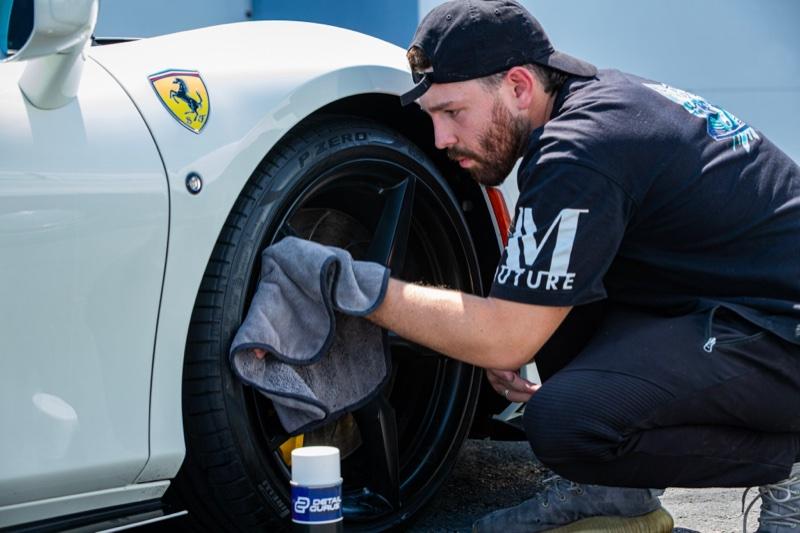
Paint correction is the machine-polishing process that removes a few microns of damaged clearcoat to erase swirls, water spots, and oxidation — it runs $349 single-stage, $699 two-stage, and $1,199–$1,899 three-stage in Las Vegas, and it's almost entirely labor. It's also what turns a $900 ceramic install into a $1,500 one, and the difference between "looks clean" and "looks better than new." Here's what each stage actually fixes, why Las Vegas paint needs it more than most, and which stage makes sense for your car.
What paint correction actually is
Your paint has three main layers: primer on the bottom, color basecoat in the middle, and clearcoat on top. The clearcoat is roughly 40–60 microns thick — about half the thickness of a human hair — and it's what gives the paint its gloss, depth, and UV protection. Everything you see when you look at a shiny car is happening in the top of that clearcoat layer.
Paint correction uses a rotary or dual-action machine polisher, a foam or wool pad, and a series of progressively finer abrasive compounds to remove a few microns from the top of that clearcoat. By leveling down the surface, defects that lived inside the clearcoat — swirl marks, water spot etching, light scratches, hazing, oxidation — disappear. The remaining clearcoat is smoother, flatter, and reflects light more cleanly, which reads to your eye as deeper color and higher gloss.
What it fixes — and what it can't
Paint correction is exclusively a clearcoat-level treatment. If a defect is in the clearcoat, we can correct it. If it has gone through the clearcoat into the basecoat or primer, we can't — that needs paint repair.
| Defect | Lives In | Correctable? | Notes |
|---|---|---|---|
| Swirl marks (cobweb pattern under light) | Clearcoat | Yes | Caused by improper washing or automatic car washes. Single-stage often removes them entirely. |
| Holograms (rotary buffing marks) | Clearcoat | Yes | From bad correction work elsewhere. Removed by a two-stage with a finishing pass. |
| Water spot etching (shallow) | Clearcoat | Yes | If caught early. Old, baked-in spots may have etched into basecoat. |
| Oxidation / chalking | Clearcoat | Mostly | Light oxidation polishes out. Heavy oxidation can be reduced but the clearcoat may be too damaged for full restoration. |
| Light scratches (catch a fingernail edge but not deep) | Clearcoat | Usually | Depends on depth. Two-stage typically handles most light scratches. |
| Deep scratches (fingernail drops fully into them) | Through clearcoat | No | Need paint touch-up or repaint. |
| Rock chips | Through clearcoat/basecoat | No | Touch-up paint or PPF moving forward. |
| Orange peel (factory paint texture) | Clearcoat surface | Sometimes | Removable with wet sanding + heavy correction. Risky — removes a lot of clearcoat. Usually not recommended on daily drivers. |
How Las Vegas conditions actually destroy clearcoat
I've worked on identical model-year vehicles from Phoenix, Vegas, and coastal California. The Vegas cars age the fastest, and there's a specific reason for it: it's not just sun, it's the combination of three things.
1. UV index above 10 for five months a year
From May through September, our UV index regularly sits at 10 or 11 — the top of the scale. UV breaks down the polymer chains in clearcoat. The clearcoat starts off flexible and clear and slowly turns brittle and chalky. On unprotected paint parked outside, you can see measurable oxidation within 18 months.
2. Surface temperatures of 150°F+ in summer
Air temperature is one thing. The surface temperature of a black hood at 2pm in July is another. We've measured 165°F on black paint and 145°F on white. Repeated thermal cycling — hot during the day, cool overnight — expands and contracts the clearcoat, accelerating polymer breakdown and opening up micro-cracks that water and dust then settle into.
3. Alkaline desert dust
Las Vegas dust is mineral-heavy and slightly alkaline. When it sits on paint and gets wet (sprinklers, the rare rain), the alkaline reaction etches the clearcoat at a microscopic level. Every dust-then-rinse cycle leaves a tiny pit. Over years, those pits become visible as a chalky haze that no wash will remove.
Stack those three together, and Las Vegas clearcoat ages about 1.5x faster than the same paint in San Diego. That's why paint correction here isn't a luxury — on any vehicle more than two years old, it's usually necessary just to get back to a baseline before you add coating or PPF.
Single-stage vs two-stage vs three-stage: when each makes sense
Single-stage correction
Single-stage uses one combined compound — a mid-cut polish with finishing capability — applied in one pass over the entire vehicle. It removes light swirls, fine wash marks, and a layer of oxidation. Expect 60–70% defect removal.
Single-stage is the right call for: relatively new cars (under 3 years) with light swirl marks, lease cars where you want a refresh before turn-in, and any vehicle where the goal is a noticeable improvement without exotic-level finish quality. Our pricing: $349 sedan, $429 SUV, $499 truck.
Two-stage correction
Two-stage uses a heavier cutting compound first (to level out deeper defects) followed by a finishing polish (to refine the surface back to high clarity). Two distinct steps, twice the machine time. Expect 85–95% defect removal.
Two-stage is the default for: any vehicle that's about to be ceramic-coated, cars 3–8 years old with visible swirl marks under direct light, vehicles that have been through automatic washes for years, and any client who wants "better than new" paint clarity. Our pricing: $699 sedan, $849 SUV, $999 truck.
Three-stage (or multi-stage) correction
Three-stage adds a heavy initial cut (often with a wool pad or aggressive foam) for paint with deeper scratches, heavy oxidation, or hologram damage from prior bad correction work. Then a medium polish, then a finishing pass. Expect 95–99% defect removal on correctable defects.
Three-stage is for: heavily neglected paint, exotic vehicles where finish quality is critical, dark colors where any remaining defect shows under light, and pre-coating prep on vehicles you plan to keep 5+ years. Our pricing: $1,199 to $1,899 depending on size and severity.
Why ceramic without correction is a waste of money
If you're getting ceramic coated, paint correction isn't optional. A ceramic coating is a transparent layer that locks in whatever is underneath it for 3 to 10 years. Skip correction and you're sealing existing swirl marks, oxidation, and water spots under the coating. Those defects can never be removed without stripping the coating first.
This is the single biggest reason cheap ceramic packages exist. A shop quoting $400 for "ceramic coating" isn't lying about the coating — they're skipping the correction. The result is a glossy, hydrophobic finish wrapped around already-damaged paint. For a daily driver you're flipping in a year, fine. For a car you're keeping, it's a permanent mistake.
How long does paint correction take?
Time on a paint correction job is almost all machine labor. Estimates:
- Single-stage on a sedan: 4–6 hours
- Two-stage on a sedan: 8–12 hours
- Two-stage on a full-size SUV or truck: 10–14 hours
- Three-stage on any size: 16–24+ hours, sometimes spread across two days
We typically book correction-only jobs as a 1-day appointment for single-stage, 2-day for two-stage, and 2–3 day for three-stage. When bundled with ceramic coating, the correction work runs in parallel with decon and ends right before the coating goes on.
When we recommend skipping correction
There are a few situations where I'll tell a client correction doesn't make sense:
- Vehicle is being sold or traded in within 60 days and the paint condition won't materially affect the offer.
- The clearcoat is failing (peeling, lifting, or showing primer through it). Correction can't fix failed clearcoat — only repainting can.
- The paint is matte or satin. These finishes can't be polished without ruining the texture. Different prep entirely.
- Very low-value vehicle where the math doesn't make sense.
How to evaluate a paint correction quote
Compare these line items between shops:
- 1.Stage explicitly named (single, two, three) and what each pass uses for product and pad.
- 2.Hours quoted for machine work, not just total shop time.
- 3.Inspection step before and after under proper lighting (LED swirl light or sun lamp).
- 4.Photos of the work documented — most serious detailers will hand you before/afters.
- 5.Paint depth measurements taken before correction begins (we use a paint depth gauge to make sure we're not thinning clearcoat below safe levels).
Related reading
Paint correction is one piece of a larger prep stack. For the full picture, read our breakdown of vehicle decontamination — the step that comes immediately before correction — and our 2026 ceramic coating pricing guide, which explains how correction work drives the difference between a $400 and a $1,500 coating quote.
Get an honest correction quote
We inspect under proper lighting, show you exactly what we see, and recommend the lightest stage that gets you to the finish you want. No upsells.
Book Paint CorrectionQuick Answers
Paint correction is the process of using a machine polisher and abrasive compounds to remove a microscopic layer of damaged clearcoat — restoring gloss and clarity by leveling out swirl marks, light scratches, water spot etching, and oxidation. It is not a wax or a coating. It is mechanical refinishing of the paint surface itself. Done correctly, the result is paint that looks better than it did the day the car left the factory.
Paint correction in Las Vegas runs $349 for a single-stage polish on a sedan, $699 for a two-stage correction, and $1,199 to $1,899 for a three-stage on heavily damaged or exotic paint. The range reflects how many polishing passes the paint needs and how much time it takes — anywhere from 4 to 20+ hours of machine work per vehicle.
Single-stage paint correction uses one combined polish to remove light defects and finish in one pass. It removes about 60–70% of visible swirls and light marks. Two-stage paint correction uses a cutting compound first to remove deeper defects, then a finishing polish to restore clarity. It removes 85–95% of defects and produces a noticeably deeper gloss. Two-stage is what most people picture when they imagine "like new" paint.
No. Paint correction removes defects that live inside the clearcoat layer — swirls, light scratches, water spot rings, oxidation, holograms. Anything that has gone through the clearcoat into the basecoat or primer is below the layer we can safely polish. Rock chips, key scratches, and deep door dings need paint repair, not correction.
Some shops skip paint correction before ceramic coating to hit a price point. It's the most labor-intensive part of a ceramic install — easily 60–80% of the total labor — so cutting it saves hours. The problem is that ceramic coatings lock in whatever's underneath them for 3 to 10 years. Skipping correction means you're sealing existing swirls and oxidation under the coating permanently. If a quote feels too cheap, this is usually what's missing.
Founder & Lead Detailer, Aqualine Performance. Pacific F2000 driver and track instructor at Dream Racing (Las Vegas Motor Speedway).
Keep reading
Car Interior Detailing Cost in Las Vegas: What You'll Pay and Why
Interior detailing in Las Vegas runs $299 for a basic clean to $899 for a full-correction detail with leather treatment and odor elimination. Here's exactly what each level covers and what makes a job cost more.
Stage 1 vs Stage 2 vs Stage 3 Paint Correction in Las Vegas: Which Does Your Paint Actually Need?
Single-stage, two-stage, three-stage — the difference isn't marketing, it's how deep the machine cuts and how much of your clear coat it removes. A one-step polish ($349) erases light swirls; a full multi-stage correction ($1,199–$1,899) chases deep scratches you can catch a fingernail on. Here's how I decide which stage a car actually needs in Las Vegas, and when correction is money you shouldn't spend at all.
Paint Correction vs Repainting Scratches in Las Vegas: Which Does Your Car Need?
Paint correction can improve a scratch only while the defect remains within usable clear coat. Missing color, exposed primer or metal, flaking clear, or uncertain paint thickness changes the answer to a body-shop assessment. Here is the inspection-first comparison I use before recommending a $349, $699, or $1,199–$1,899 correction tier — including the cases where I decline the detailing job.